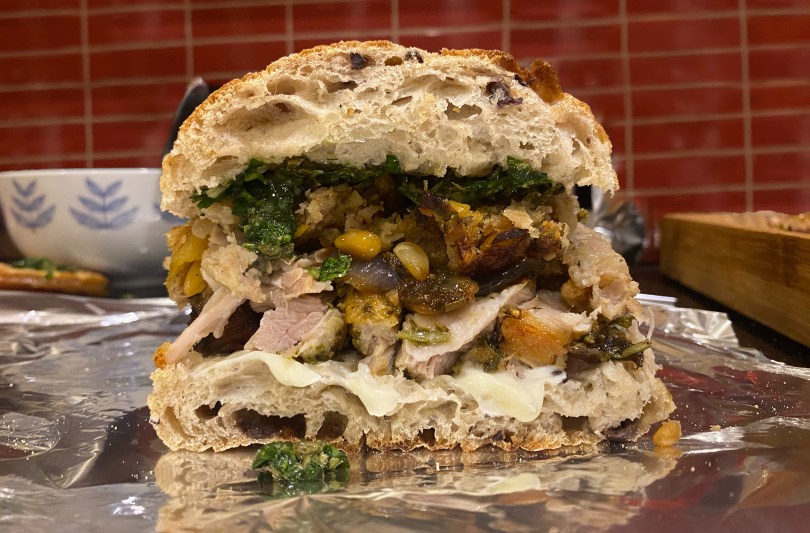
Porchetta Sandwich

Porchetta Style Pork Belly Sandwiches

I absolutely love porchetta, but for 2 reasons it’s not really practical for me to make on the reg:

  1. I’m usually only feeding 2-4 people
  2. I can’t easily get my hands on a 5kg slab of pork belly…

So, I came up with this recipe which uses the flavours of porchetta, but on a much smaller scale. Smaller in size, but just as big in flavour. This is a hearty, Italian comfort meal loved by everyone I’ve ever made it for, perfect for picnics or winter meals in. The pork & stuffing are very rich, but the fresh & salty salsa verde really cuts through that. It would also be delicious with some pickled onions added to cut through the richness even more.

I love this in a sandwich with the stuffing, salsa verde & the rest – but the pork belly would work just as well on it’s own as the centre piece of a roast. You can take the components of this dish & make it your own!


Porchetta Style Pork Belly Sandwiches With Salsa Verde and Sausage & Apricot Stuffing

Ingredients

Pork Belly:

600g piece of pork belly, skin on

Large handful parsley

Large hanndful sage

Large handful rosemary

4 large cloves garlic

1/2tbsp fennel seeds

1 white onion

75ml olive oil + extra to coat onions

Sea salt

Sausage & Apricot Stuffing:

1tbsp butter

1/2tbsp olive oil

1/2 white onion, diced

25g pine nuts

8 sage leaves, finely chopped

Small handful parsley, finely chopped

60g dried apricots, diced

75g bread crumbs

200g sausage meat

Salsa Verde:

Large handful of parsley

Large handful of basil

Small handful of mint

1 large garlic cloves

4 anchovy fillets

1tbsp capers

40ml extra virgin olive oil

Sandwich Assembly:

Nice bread – ciabatta or foccacia work well

A few tbsp good quality mayo

Pork Belly:

  1. Preheat the oven to 250°C/230°C fan (or as hot as it will go)
  2. Toast the fennel seeds in a dry pan until fragrant. Grind them in a pestle & mortar.
  3. Put the herbs, garlic, fennel seeds & olive oil into a food processer & pulse until the garlic & herbs are broken down. You want this to be a little chunky still, not a paste.
  4. Slice your onion into coins & place these in the bottom of the roasting tin, this will form the bed for the pork. Lightly coat these in olive oil.
  5. Score the pork belly skin in diagonal strips. Score the underside of the belly into diamonds (i.e. diagonal cuts in both directions)
  6. Rub the fleshy side of the pork generously with sea salt, followed by the herb mix. Place the pork herb side down onto the onions.
  7. Pat the skin dry with kitchen roll, then salt the skin generously. It’s important to do this just before you put it in the oven, if left out the salt will draw the water of the skin and will need to be dried again.
  8. Put the pork in the over for 10-20 mins or until the skin crisps up. Reduce the heat to 160°C/140°C fan & cook for a further 1-1.5 hours.
  9. If at the end of the cooking time the skin needs crisping up a little, cook under a hot grill until crisp. Keep a VERY close eye on this, it can burn very quickly.

Sausage & Apricot Stuffing:

  1. Heat the butter & oil in a pan over medium heat. Add the onion & cook until softened (about 5-10 mins) – try not to let these catch.
  2. Toast the pine nuts in the oven with the pork for about 5-10 mins until golden. Keep a very close eye on these as they can burn very quickly!
  3. Combine all remaining ingredients in a bowl, with the fried onions & toasted pine nuts. Season with salt & pepper (you can taste for seasoning by frying up a small amount)
  4. Push the stuffing mix into a baking dish (22x16cm)
  5. Bake in the oven for 45mins-1hour until golden on top & cooked through.

Salsa Verde:

  1. Chop all ingredients bar the oil on a board until finely chopped.
  2. Transfer this to a bowl & mix with the oil.

Assembly:

  1. I like to warm the bread in the oven for 5-10 mins before assembly.
  2. Remove the crackling from the pork belly & set aside. Slice the pork belly.
  3. I like to make my sandwiches on a piece of foil so when they’re done I can wrap them up tightly. This makes for easier eating
  4. Cut the bread open. Spread mayo on the bottom layer, add the pork belly on top followed by the roasting tin onions. Add stuffing followed by a heapinng dollop of the salsa verde. Top with the other half of the bread & enjoy!
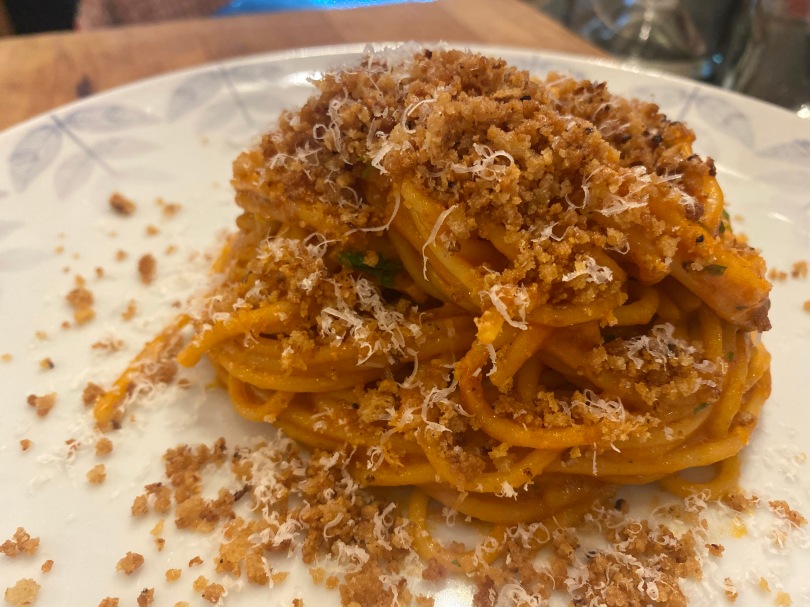
Garlicky anchovy pasta

Speedy Garlicky Anchovy Pasta

Even when I don’t have much time to cook, I refuse to sacrifice deliciousness. I created this pasta for such situations. I used strong flavours to make it exciting despite its simplicity (think salty, anchovy-y, tomatoey goodness). It uses mostly store cupboard ingredients too so not only is it quick to cook, you might not even need to go to the shop. As the cooking of the pasta is finished off in the sauce, the sauce ends up feeling very luxurious and clings to the pasta. This truly is a speedy dinner as the sauce is cooked in the time it takes the pasta to cook.


Speedy Garlicky Anchovy Pasta

Serves 2

15 mins prep + cooking

Ingredients

150g linguine or spaghetti (or any pasta really, but it works well with a long pasta)

1.5 tbsp olive oil

6 anchovy fillets in oil, roughly chopped

4 garlic cloves thinly sliced (or 2 large cloves)

Juice 1/2 lemon

2 tbsp tomato puree

1 tbsp butter (or more to taste)

4 tbsp grated parmesan (or more to taste, plus extra for serving)

Handful of parsley chopped

Panko breadcrumbs to serve (if you can get your hands on lemon & black pepper breadcrumbs, get those!) see the note for how to make the breadcrumbs a little fancier

Method

  1. Add your pasta to salted boiling water and cook for a few minutes less than the packet says.
  2. Meanwhile, add your oil and anchovies to a frying pan on medium high heat and cook until the achovies dissolve.
  3. Add the sliced garlic and cook until lightly golden
  4. Add the lemon juice to the pan and cook until mostly evaporated.
  5. Add the tomato puree and cook for a few minutes, stirring regularly until the colour darkens slightly. Take off the heat until the pasta is ready.
  6. Once the pasta is cooked, put the frying pan back onto medium high heat and transfer the pasta over being sure to reserve the pasta water. Add 100-200ml of pasta water to the frying pan and bring to a boil, stirring often, until reduced to almost nothing. Repeat this process until the pasta is cooked to your liking.
  7. Take the pan off the heat and add the butter & Parmesan. Stir through and add more butter/Parmesan to your taste. Add the chopped parsley.
  8. Serve with more parm and the breadcrumbs sprinkled over

Note: If you have time, I definitely recommend sprucing up your bread crumbs a little. In a frying pan heat up 1 tbsp oil + 1/2 tbsp butter with 2 minced cloves of garlic. Fry until golden, then add breadcrumbs (NOT panko) and fry those until evenly golden.

Gingerbread House: Top Tips

This year I challenged myself to make my best gingerbread house yet, and I think I succeeded (feedback from my family, not just me patting myself on the back). This took me about 4.5 days of baking, decorating & building – and I have 0 regrets about how I used that time. In fact, I think this is probably my favourite way to spend the days up to Christmas. It’s no surprise I love being in the kitchen, so getting to spend 4 days solid working on something while watching ‘Are You Scared?’ on YouTube (my idea of festive viewing) is kind of my dream. Plus it makes for the best Christmas decoration.

My Process

My process for making a gingerbread house starts with trawling Pinterest for inspiration – this was my board for this year. I landed on doing a Victorian style house with bay windows, a balcony and double roof. I used this house to model mine on. The next stage is I give the pictures to my engineer dad & he magically turns it into working templates. I have very little knowledge about how this part works…

Next I move onto the baking. This year I made a double batch of this BBC Good Food gingerbread recipe – the raw dough is so good I’m surprised any of it got baked up. I roll the dough about 0.5cm thick (some key pieces a little thicker for stability) & use a sharp knife to cut out around the templates.

After baking the dough expands a little so, once cooled completely, I flatten off and trim the edges using a microplane grater, checking against the templates. This makes sure the pieces will fit together flush when it comes to building. The baking & trimming took me a full day.

The next step is to decorate. For this I used 1 batch of royal icing from the same BBC Good Food recipe. I used gelatine leaves as window panes by attaching them behind the window with royal icing. Once these had dried enough, I flipped the pieces at did aaaall the royal icing decoration – this took me about 4/5 hours. I left these to dry for a few hours. I keep my royal icing fresh by clipping the top of the bag and covering the tip with cling film.

To build, I used royal icing on a chopping board. I first but up the walls, then left it to set overnight before attaching the roof. Then added all the external decoration pieces & candy canes. PSA: Candy canes are very hard to saw without shattering… I used chocolate buttons to tile the roof – this can only be done once the roof gingerbread pieces are fully set. I added a few icicle details & then filled in the board with royal icing (I had to make a second, slightly thinner batch to do this).

And there you have it – a mere 4.5 days of work later – a Gingerbread House! The funny thing is, I don’t really like gingerbread… So now it’s up to my family to eat it all.

The finished house – fairy lights and all

Top Tips

So, having spent days on this thing I thought I’d share some of the things I’ve learnt along the way to help you make a successful custom gingerbread house:

  1. Spend time on the templates. It’s worth spending a little extra time on these to make sure it works, as this is hard to fix when it comes to assembly. You could even make a card mock-up to check everything fits.
  2. It’s better to cook your gingerbread a teeny bit longer than normal to make sure it’ll cool hard all the way through. I added 1-2 mins to the cooking time.
  3. Always shave the sides of your gingerbread. Gingerbread expands slightly meaning it’ll be bigger than the templates and make not fit together properly. I used a microplane grater to do this.
  4. Always make a few extra gingerbread fingers. These came in really handy this year when I realised one of my walls was too short. I propped it up on my extra gingerbread – which really saved the house.
  5. Decorate your pieces before attaching – this is much easier horizontal than it is vertical.
  6. When putting together the walls, pipe a little extra icing along the inside of the join for extra stability.
  7. I had to use dowels on the back of the pieces making up the tallest point, as these started to bend slightly as they got stale. So if you have any extra tall/thin pieces be sure to stabilise then using dowels & royal icing to attach.
  8. ‘Snow’ covers a multitude of sins – if something’s gone slightly wrong or a seam looks a little dodgy, cover it in royal icing and act like that was always meant to be there.
Christmas pasta bake

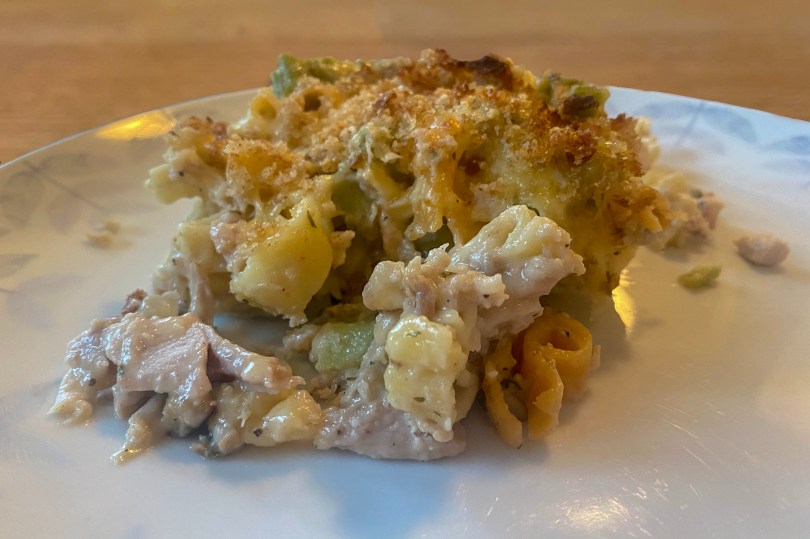
Christmas Leftovers Pasta Bake

Christmas dinner is the meal that keeps on giving. I don’t know if your family do the same but we will make a meal big enough to feed at least double the number of people actually coming for Christmas day (there was over half a Turkey left this year). So the fun challenge over the next few days is finding ways to transform the leftovers into something completely different so it doesn’t feel like we’re eating the same meal over and over. This year I had the craving for pasta (what’s new?) so I though of a leftovers pasta bake which uses the turkey/stuffing and some cheese board leftovers. A pasta bake/mac and cheese/Christmas roast crossover. The most ambitious crossover event in history.


Christmas Leftovers Pasta Bake

Serves 6 | 30 mins

Ingredients

450g short pasta (fusilli, penne, rigatoni – I used some Christmas Pasta like this one)

50g butter

2 cloves garlic, crushed

50g plain flour

700ml milk

6 tbsp grated parmesan

500g turkey & stuffing (or other meats) leftovers, roughly chopped – I used turkey, chestnut & sausage stuffing

~100-200g leftover hard cheese grated (cheddar, Gouda or Gruyere would work well – something with flavour that will melt)

Juice 1/2 lemon

150ml 1/2 fat creme fraiche

1-2 slices day old sourdough (or whatever bread you have), processed into breadcrumbs

1 tsp olive oil

Method:

  1. Bring a large pan of salted water to the boil, add your pasta & cook until al dente (you may want to do this after you’ve started on the sauce, depending on the cooking time for the pasta)
  2. Meanwhile, melt the butter in a medium saucepan over medium heat. Add the crushed garlic & cook until lightly golden.
  3. Add the flour & cook stirring continuously for 1-2 mins
  4. Add the milk gradually, whisking until smooth between each addition. If you have any leftover gravy, you could also add this to the sauce as this point for some extra flavour.
  5. Cook this, mixing continuously, for a few minutes until thickened. Stir in some pepper, 4tbsp of grated parmesan & a few handfuls of your grated hard cheese of choice (make sure there is enough leftover to sprinkle over the bake at the end).
  6. Add the pasta, turkey meat/stuffing & creme fraiche to the sauce. The creme fraiche is needed to cut through what is otherwise a very rich dish.
  7. Season this to taste with salt, pepper & lemon juice.
  8. Turn your grill onto high heat.
  9. Pour the pasta into an 30cm x 20cm baking dish. Sprinkle the grated hard cheese over the top. In a separate bowl stir together the breadcrumbs, remaining 2tbsp of parmesan and 1tsp olive oil. Spread this mix over to the top of the pasta.
  10. Grill for a few minutes until the cheese is melted & the breadcrumbs have browned. Keep an eye on this as it can burn very quickly.
Frangipane Mince Pie

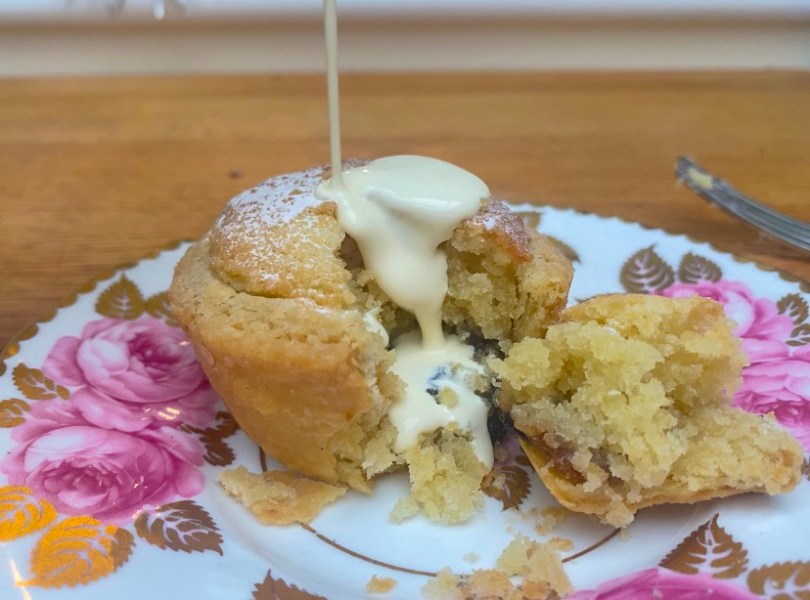
Frangipane Mince Pies

This is the perfect festive pie for mince pie lovers & haters (but bad for almond haters). This combines a mince pie & a Bakewell – which is a great way to get mince pie haters to love mince pies, or at least a version of a mince pie. This elevates a mince pie from an afternoon snack to a fully fledged dessert when served warm with heaps of double cream.

This combines an extra short, melt in the mouth shortcrust, sweet mince meat & a buttery frangipane. An unbeatable combo. Speaking of melt in the mouth pastry, I’m gonna share with you the well kept secrets of keeping your pastry as short & crumbly as possible:

  1. Keep it as cold as possible
  2. Handle it as little as possible to stop gluten developing

Name a better way to get into the Christmas spirit than baking (& subsequently eating) a batch of these while watching a Christmas movie.


Frangipane Mince Pies

Makes 12 | 40 mins prep / 30 mins cooking (+2hour min chilling)

Ingredients

Pastry:

175g chilled unsalted butter

250g (+1tbsp) plain flour

1tbsp caster sugar

Pinch of salt

1 egg yolk

2-3tbsp ice cold water

Frangipane:

125g butter, room temp

125g caster sugar

2 eggs, room temp

125g ground almond

30g plain flour

Pies:

12tsp mince meat

Method

  1. Cut the butter for the pastry into cubes, toss with 1tbsp of plain flour and put in the freezer for 5 minutes.
  2. Add the remaining flour, sugar & salt to a food processor & pulse to combine. Add the cold butter and pulse to form a breadcrumb-like texture. (See the note if you are making the pastry by hand)
  3. Add in the egg yolk & blend to combine. Then add the water in small amounts, blending to form a dough that sticks together when squished in your hand. You want to add as little water as possible to reach this stage, so add it in stages.
  4. Tip the dough onto a work surface and kneed very lightly until it just comes together to form a ball. Wrap in cling film and chill for at least 2 hours.
  5. In the meantime, make the frangipane. Beat the butter & sugar together. Then add the eggs 1 at a time, beating well between each addition.
  6. Add the ground almonds and sift in the flour and stir to combine
  7. Preheat your oven to 180°C/160°C fan
  8. Remove the pastry from the fridge & cut in half, return half to the fridge.
  9. Roll the other half out on a lightly floured surface to just under 0.5cm thick. Cut into rings big enough to line your muffin tin.
  10. Push the pastry disks into the tin. Use a small ball of pastry offcuts to push the dough into the bottom of the tin & into the edges. Squish any offcuts together & return to the fridge
  11. Repeat with the other half of dough & any offcuts (don’t re-roll the dough more than once, after this it’ll start to get tough).
  12. Once all 12 holes are lined, start on the filling. Spoon in 1tsp of mince meat into the base of each pastry case & spread to an even layer. Spoon on ~1tbsp of frangipane on top & spread flat (this should be very close to the top of the pastry case)
  13. Bake for 25-30 mins until golden.
  14. Dust with icing sugar & serve warm with heaps of double cream

Note: To make your pastry without a food processer, combine the flour, salt & sugar in a bowl. Add in the ice cold butter and rub with your fingers to form a breadcrumb texture. Add in the egg yolk & stir with a palette knife until combined, then add water in small amounts & stir to form a dough that sticks together when squished.

Miso Peanut Butter Noodles

Miso & Peanut Butter Ramen Noodles

This is one of my all time favourite recipes that I’ve created. When I finally got this recipe spot-on, I knew I’d created something great. So great that I made another bowl of if for breakfast the next day… And then again for dinner later that week… This dish combines miso, peanut butter & mushrooms for a rich, thick sauce that really packs an umami punch. My favourite way to have this is with sausage & a jammy boiled egg, but this can easily be made veggie by swapping the sausage for a different protein & the beef stock for veg stock, and vegan by removing the egg! The ultimate upgrade for your packet ramen. Speaking of packet ramen, you can use whichever brand you like for this dish. I use Chapaghetti because I love the thickness of the noodle (slightly thicker than your average packet ramen). I cannot stress enough how much you need to try this recipe – you will not be disappointed.


Miso & Peanut Butter Ramen Noodles

Serves 1 | 20 Mins Prep + Cooking

Ingredients

1 packet instant ramen noodles (I use Chapaghetti)

1.5tbsp chunky peanut butter (my fave is Manilife Deep Roast)

1.5tbsp white miso paste

2tsp soy sauce

1/2tsp beef stock concentrate

150g Chestnut mushrooms, sliced ~0.5cm thick

1 large garlic clove, minced

A handful of parsley, finely chopped

1 egg

Optional: 1 sausage, removed from casing

Method

  1. Boil the egg for 7 mins, once cooked set aside in a bowl of iced water until ready to use.
  2. Heat a small frying pan medium high heat adding ~1tsp olive oil. Break the sausage meat into chunks and flatten slightly. Fry for a minute or two (depending on how hot the pan is) on each side until caramelised and cooked through. Set aside until ready to use.
  3. Add the mushrooms to the same frying pan, add a little more oil if it’s too dry, and fry until all the water has been released, has evaporated and the mushrooms are starting to brown.
  4. Add your crushed garlic and fry, stirring often, until fragrant.
  5. Next add the miso, peanut butter, soy sauce, stock & enough water so that once the noodles are added, they will be submerged. Stir this until well combined & smooth apart from the mushrooms.
  6. Bring this mix to the boil & add the noodles. Cook this, stirring frequently, until the noodles are cooked through and the sauce has reduced and thickened to the texture of thick double cream.
  7. While this is cooking, roughly chop the sausage into mouth-sized chunks. Peel and half the egg.
  8. Once the noodles are cooked, stir through the parsley. Serve in a bowl with the egg & sausage on top.

Note: If you don’t have stock concentrate, swap the water for stock of your choice

Veggies/Vegans: Make this dish veggie by swapping the sausage for a protein of your choice & swapping the beef stock for veg stock. Omit the egg to make it vegan

Italian Sausage Rolls

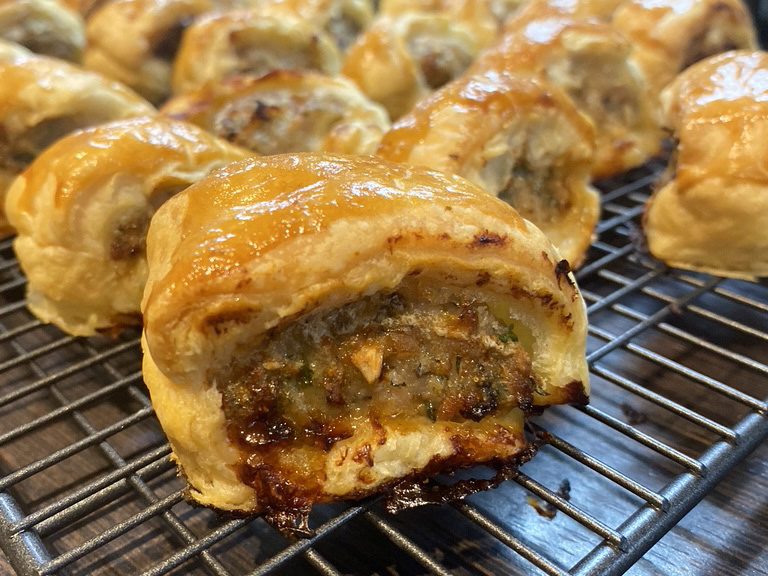
These are my go to for pretty much any occasion. Picnic on a park? Italian sausage rolls. People coming for dinner that you want to impress? Italian sausage rolls. Think all the comfort of a sausage roll but with the push of Italian flavours. Im talking garlic, pecorino, fennel & my secret ingredient anchovies. These sausage rolls are so simply but always seem to impress. And the best part: frying up the sausage meat to taste for seasoning (chef’s perks).


Italian Sausage Rolls

Makes ~20-24 mini rolls | 20 min prep / 25-35 min cooking

Ingredients

400g sausage meat (or sausages removed from casing)

2 fat cloves of garlic, minced

3 anchovy fillets, finely chopped

Handful of parsley, finely chopped

2 tbsp fennel seeds,  ground (use pestle mortar, coffee grinder or a sharp knife)

1tbsp freshly grated parmesan

1tbsp  freshly grated pecorino (or another tbsp parm)

½ tsp dried thyme

1.5 tsp oregano

¼ tsp garlic powder

¼ tsp onion powder

A few shakes of chilli flakes

1 roll puff pastry

1 egg + splash milk beaten

Method

  1. Preheat the oven to 200°C/180°C fan
  2. Add all ingredients apart from the pastry, egg and milk to a bowl. Add some freshly ground pepper and a pinch of salt (you won’t need much as the cheese and anchovies are already quite salty). Mix until combined
  3. Taste the sausage mixture by frying a small amount and adjust seasoning accordingly
  4. Once happy with the seasoning, unroll your puff pastry and cut in half lengthwise. 
  5. Form half the sausage mix into a log going the length of one piece of the pastry. The sausage should be even in width and reach end to end.
  6. Brush the egg mix along the far side of each pastry piece running parallel to the sausage. Roll the near side of the pastry over the sausage, keep rolling until it hits the egg wash. Repeat on the second piece of pastry.
  7. With the seam pointing down, brush the top of the logs with egg wash. Cut each log into 10-12 pieces (or less, depending on the size you want). Arrange these on a baking sheet lined with non-stick paper.
  8. Bake for 25-35 mins until golden brown. Enjoy still warm from the oven!

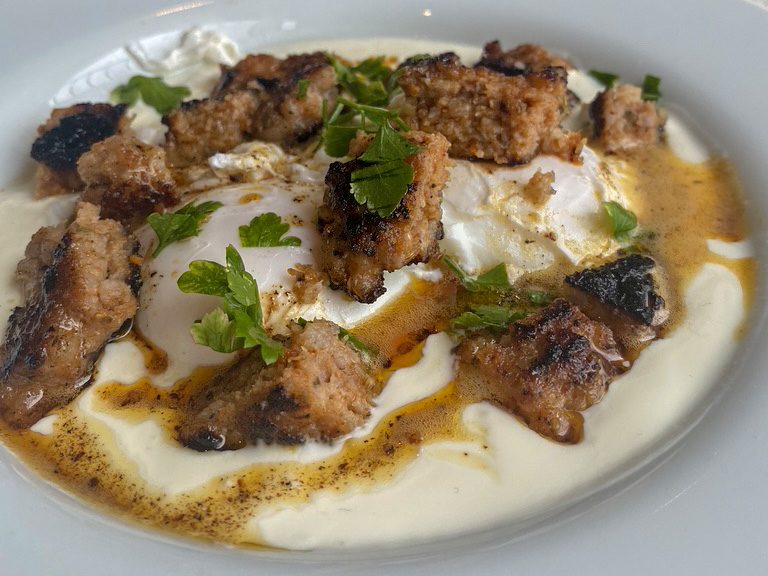
Turkish Eggs With Spicy Sausage

Have you been searching for a breakfast that takes less than 30 mins but will have anyone who eats it thinking you’re a professional chef who got up at 5am to cook their breakfast? Well, I have some great news for you – I’ve created this recipe for the non-morning people who want sleep AND a tasty breakfast.

The best thing about this recipe is that the yoghurt is white so its hides how badly done my poached eggs are… Not really, the best part is how unbelievably TASTY this thing is. Turkish eggs have been a firm brunch fave of mine since I had them in a deli once when I was 17 but I haven’t found them in many restaurants since. We have creamy garlicky yoghurt, sweet & spicy sausage, spicy oil and runny eggs, all scooped up with some good quality bread. Can it get any better than that at breakfast time?!


Turkish Eggs With Spicy Sausage

Serves 2 | 30 mins prep + cooking

Ingredients

Sausage Mix:

4 pork sausages, casings removed OR ~250g sausage meat

1tsp smoked paprika

1/2tsp cayenne pepper (more if you like spicy, less if you don’t)

1/4tsp cinnamon

1 large clove garlic, minced

2tsp honey

Salt, to taste

Turkish Eggs:

250g full fat Greek yoghurt

1 large clove garlic, minced

30g butter

1-2tbsp olive oil

1/4-1/2 tsp chilli flakes

4 eggs

A few sprigs of parsley to garnish

Good bread to serve, e.g. focaccia, sourdough

Method

  1. Add all ingredients for the sausage into a bowl and mix with your hands until all the spices are fully incorporated. Taste for seasoning by frying up a small amount of the mix, adjust as needed.
  2. Heat the olive oil in a frying pan over medium high heat. Add gold ball sizes of sausage meat, flattened (this doesn’t need to be neat as you’ll chop them up later), into the pan. Don’t overcrowd the pan, do in batches if necessary. Cook for 2-3 mis on each side until cooked through, cooking time will depend on you pan, hob and thickness of the patties (test a patty by cutting into it and checking for any pink). Set the sausage aside and chop roughly into chunks.
  3. To the sausage pan, add the butter and cook on medium heat until the foaming subsides. At this point, remove the pan from the heat and stir in your chilli flakes. It should froth slightly.
  4. Heat some water in a wide deep pan over medium heat.
  5. In a heatproof bowl, combine the yoghurt, garlic and salt to taste. Warm this mix in the hot water to body temperature.
  6. Next step is to poach your eggs (see note)
  7. To assemble, spoon the yoghurt into a wide bowl. Place 2 eggs on top and arrange the sausage around the eggs. Spoon over some of the chilli/oil/butter mix. Serve with some chopped parsley and good bread.

Note: I am by no stretch of the imagination an eggs-pert at this so please use whatever method you prefer. But if you want to try method, here it is:

  1. Add 1-2tsp of white wine vinegar to the wide pan of water. Heat the water to 180 degrees C.
  2. Crack your fridge cold eggs into a small bowl or ramekin.When the water is to temperature, scrape away any bubbles that form in the pan. slightly submerge the bowl so some water from the pan enters, the tip the egg out.
  3. Scoop around and over the egg to try and form its into a ball
  4. Cook for 2-4 mins, until to your desired runnniness.